Have you ever wondered why some companies grow so quickly, while others remain stuck just dealing with software updates and data synchronization? In my professional life, I have seen many ERP systems, but the level of clarity and power I found in information about FoxTPAX software is something you rarely see. If you want to turn your business from manual to automated and smart, then this article is for you.
What is FoxTPAX Software?
In simple words, FoxTPAX is the “brain” of your business. When your accounting, customer relations, and supply chain run on separate software, the data remains scattered. FoxTPAX brings everything under one roof. This is not just an ordinary management tool; it is a modular operating system. Its biggest strength is its three-tier architecture.
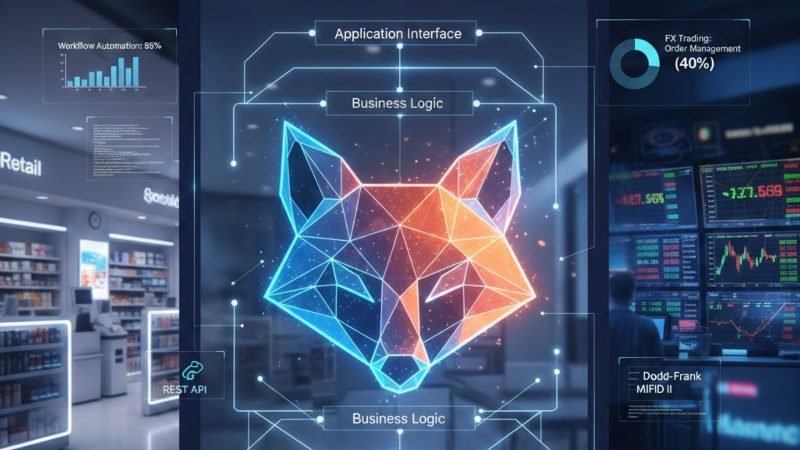
This architecture keeps the application interface, business logic, and data storage completely separate. The advantage is that whether your business is run by 10 people today or 10,000 tomorrow, the system speed does not change. Organizations deploy FoxTPAX to replace fragmented software suites so the gap between accounting and project management can be eliminated. If you enjoy exploring modern technology platforms and digital systems, you can also check out this detailed guide on RevolverTech gaming to see how advanced platforms manage performance and data.
A Practical Hook from My Experience
Once a client called me. He was very worried about his FX trading module because his old system could not calculate at the speed of the market. When we switched him to FoxTPAX, he realized that the work that previously took him two hours was now happening in real time. That is when I understood how important it is to have information about FoxTPAX software for people who want to save both time and money.
What is FoxTPAX Software Python Integration?
Now let’s come to the question that has been keeping developers awake: what is FoxTPAX software Python integration? Look, FoxTPAX is not just a click-and-play tool. Its real power lies in its API and Python support. When we say FoxTPAX integrates with Python, it means you can go beyond the system’s limitations. Tools like Zapier can also help connect different apps and automate workflows.
- Custom Automation: If there is a rule that does not exist in the system by default, write a Python script and the job is done.
- Predictive Analytics: Take FoxTPAX data, put it into Python libraries like Pandas or Scikit-learn, and predict how many sales will happen next month months in advance.
- System Interoperability: Python works as a bridge through which FoxTPAX can communicate with any legacy database or third-party cloud service.
Key Features of FoxTPAX (Key Functional Modules)
1. Workflow Automation (That Saves Your Time)
The FoxTPAX engine runs on “conditional logic.” Example? When a customer places an order on the website, the system automatically:
- Updates the stock.
- Generates an invoice and sends it to the customer.
- Sends a notification to the shipping team.
There is no room for human error anywhere in this process. Achieving automation levels of up to 85% with this system is not a big deal.
2. Unified Dashboard Interface
The dashboard is so clean that even non-technical staff can learn it in two days. Sales figures, support tickets, and project progress all appear on one screen. This centralized view makes decision-making up to 50% faster.
3. FX (Foreign Exchange) Trading Module
For financial institutions, this module is like a weapon. Order management, position tracking, and margin calculation all happen live.
| Trading Function | Distribution |
| Order Management | 40% |
| Risk Analysis | 30% |
| Compliance | 20% |
| Reporting | 10% |
For regulatory compliance such as Dodd-Frank and MiFID II, the system automatically prepares reports so you don’t break into a sweat during audits.
Security and Protection You Need
The world is changing, and attacks are increasing. FoxTPAX is SOC 2 Type II certified. This means your data is locked behind military-grade encryption. Because of forensic logging, you can track every click and see who changed what. Multi-factor authentication and role-based access control ensure that sensitive data only reaches the right people.
Deployment: Choose the best Module
- Cloud SaaS: For those who want to start quickly and do not want the burden of maintenance. It usually takes 1–2 weeks.
- Private Cloud: Best for regulated industries where data security is the top priority. It usually takes 4–6 weeks.
- On-Premise: An 8–12 week setup for organizations that want full internal control.
Comparison: FoxTPAX vs Traditional ERP
| Feature | FoxTPAX Software | Traditional ERP |
| Implementation | 8–16 Weeks | 6–12 Months |
| Customization | Through Configuration | Requires Coding |
| User Training | 2–3 Days | Takes Weeks |
| Python Support | Native / Built-in | Very Difficult |
Implementation Process: From Assessment to Adoption
The FoxTPAX implementation process happens in four stages:
Requirements Assessment: Identify bottlenecks and performance baselines.
- Data Migration: Clean legacy data and map fields.
- Pilot Deployment: Run tests with a small user group so configuration issues can be identified.
- Training: Documentation and support teams help increase user adoption.
Conclusion: What Is the Next Step?
Brother, gathering information about FoxTPAX software is the first step, but actually trying it should be the real goal. In business, the one who adapts quickly with time is the one who wins. If you want to automate your workflow and give new meaning to your data with the power of Python, there is no better option in the market than FoxTPAX.
If you ask me, first take its demo, then sit with your technical team and explore its Python capabilities. This system has the ability to take your company’s efficiency to the next level. For more information, visit PBL Emulators.
FAQs (Information about FoxTPAX software)
Q: Do I need to know programming?
No. If you are only a user, you do not need code. But if you are a developer, the what is FoxTPAX software Python integration feature is a jackpot for you.
Q: Is it for startups or large companies?
That is the beauty of it. A small company can start with basic features, and a large company can enable all modules (FX, Risk, Analytics). It grows with you.
Q: How much does implementation cost?
A standard setup is usually equal to 20–30% of the annual subscription fees, which is much lower than the hundreds of thousands of dollars often required for traditional ERPs.