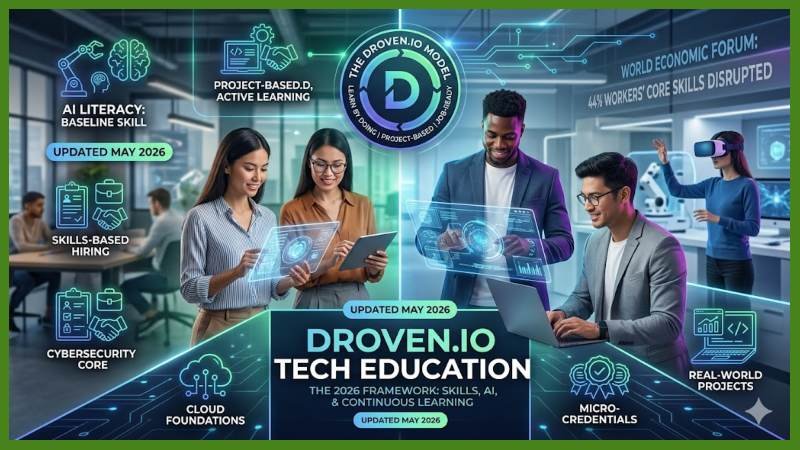
I want to start with a number that stopped me cold: according to the World Economic Forum’s Future of Jobs Report, 44% of workers’ core skills are expected to be disrupted within the next five years. Not gradually disrupted — sharply, quickly, and without warning for those who are not paying attention.
That is the context behind droven io tech education trends. This is not a buzzword. It is a framework for understanding how education — specifically technology education — must evolve to keep pace with a job market being rewired by AI, automation, and digital infrastructure.
I spent time auditing the top-ranking articles on this topic and found that most cover the surface. They list 10 trends, add some bullet points, and call it done. That is not enough anymore. In this article, I am going to go deeper — into the mechanics of why each trend exists, what it means practically for a student or educator today, and what nobody else is telling you about where this is all heading.
Quick Reference: Droven io Tech Education Trends at a Glance
| Category | Details |
| Topic Focus | Tech Education Trends — Droven.io Framework |
| Year | 2026 (Updated May 2026) |
| Audience | Students, Educators, Tech Professionals, Career Switchers |
| Key Drivers | AI, Cloud Computing, Skills-Based Hiring, Remote Learning |
| Top Skills in Demand | AI Literacy, Cybersecurity, Data Analytics, Cloud, DevOps |
| Learning Formats | Micro-credentials, Bootcamps, Project-Based, Hybrid Classrooms |
| Biggest Challenge | Keeping curriculum aligned with fast-changing industry needs |
| Global Adoption Rate | EdTech market projected to exceed $400B by 2028 |
| Verdict | Skills-first learning is no longer optional — it is the standard |
What Exactly Is the Droven.io Approach to Tech Education?
Before we get into individual trends, let’s be clear about what droven io tech education trends actually refers to.
Droven.io represents a philosophy of education that is outcomes-driven, skills-first, and technology-integrated. It is not tied to a single institution or platform. Instead, it describes the convergence of several forces: employer expectations shifting toward demonstrated competency, technology making personalised learning scalable, and global access to education breaking down geographic barriers.
The old model: sit in a classroom, absorb theory, earn a degree, get a job. That model is not dead — but it is no longer sufficient on its own.
The droven io model: learn by doing, demonstrate through projects, earn credentials that employers actually recognise, keep learning continuously. This is the framework shaping 2026 tech education worldwide.
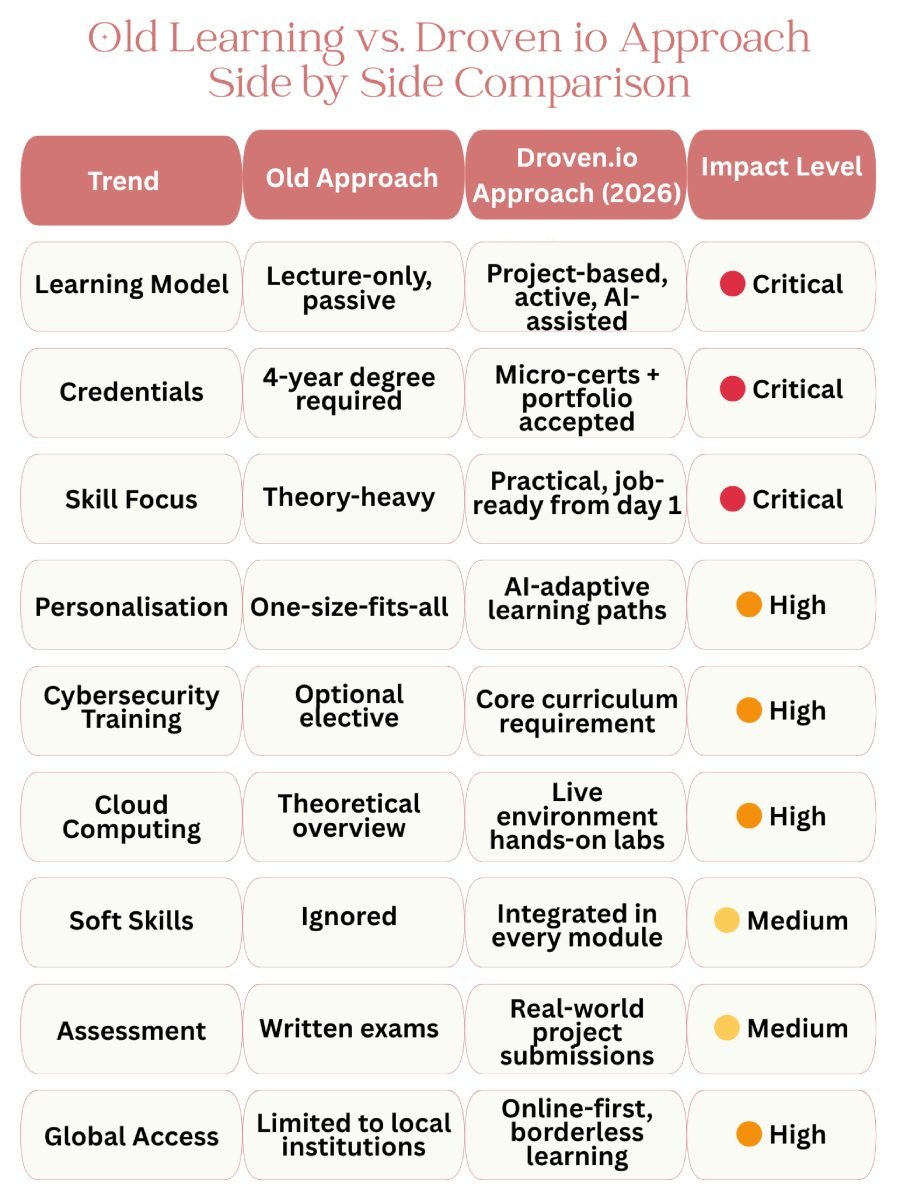
Old Learning vs. Droven io Approach — Side by Side Comparison
Interactive games are transforming how students absorb information. For instance, platforms like Gimkit allow teachers to gamify lessons easily. If you’re new to the platform, check out this guide on how to become a Gimkit host to start running your own engaging sessions.
Trend 1: AI Literacy Is Now a Baseline Requirement, Not a Bonus
Two years ago, knowing how to use AI tools was impressive. Today, not knowing how to use them is a liability. That is how fast this shift has happened.
Droven io tech education trends place AI literacy at the very top of the priority list for 2026. And this does not just mean knowing how to type prompts into ChatGPT. Genuine AI literacy includes understanding how to:
- Select the right AI tool for a specific task
- Evaluate AI-generated outputs for accuracy and bias
- Use AI in workflows without creating new risks
- Understand ethical implications of AI decisions
- Communicate AI limitations clearly to non-technical stakeholders
What makes this trend different from earlier tech education shifts is speed. Cloud computing took a decade to become a curriculum staple. AI literacy is being built into courses within months of new tools launching. The education cycle has compressed dramatically.
For educators, this means constant curriculum updates. For learners, it means that a course you took 18 months ago on AI tools is already partially outdated. This is the new normal.
Trend 2: Skills-Based Hiring Has Permanently Altered What Degrees Are Worth
This is the trend that makes traditional universities uncomfortable, and with good reason.
Major tech employers — including IBM, Google, Apple, and Accenture — have publicly removed degree requirements for many roles. What replaced the degree requirement? Demonstrated skills. Portfolio work. Certifications. Real project experience.
Droven io tech education trends reflect this shift completely. The question is no longer ‘where did you study?’ It is ‘what can you actually build?’
What Skills-Based Learning Looks Like in Practice
A learner following the droven io model in 2026 might take a 12-week cloud computing bootcamp, earn an AWS Solutions Architect certification, build three portfolio projects — a serverless app, a data pipeline, and a security audit — and land a junior cloud engineer role at a $75K starting salary. Total time: under a year. Total cost: a fraction of a four-year degree.
This is not a hypothetical. It is happening at scale right now. And it is disrupting the economics of traditional higher education in ways that will take a decade to fully play out.
For anyone considering a career in tech today, the honest advice is this: build skills, document them publicly, and let your work do the talking. The credential matters less than the proof.
Trend 3: Cloud Computing Education Has Gone From Optional to Foundational
Five years ago, cloud computing was a specialisation. Today it is infrastructure — invisible, assumed, and essential.
Almost every modern tech role touches cloud in some way. Developers deploy on cloud platforms. Data analysts pull from cloud databases. Security professionals protect cloud environments. Product managers understand cloud costs and constraints. You cannot work in tech without at least a working understanding of cloud systems.
Droven io tech education trends reflect this by treating cloud not as a separate track but as a foundational layer underneath everything else. The best courses now integrate cloud environments directly — students work in live AWS, Azure, or Google Cloud consoles from day one rather than reading about cloud in theory.
The multi-cloud angle is particularly important in 2026. Organisations rarely use just one provider. Learners who understand only AWS and not Azure are limiting their options. The droven io approach pushes for cloud-agnostic fundamentals first, then platform-specific depth.
Trend 4: Cybersecurity Is No Longer a Specialty — It Is Everyone’s Problem
Global cybercrime damage is projected to reach $10.5 trillion annually by 2025. Ransomware attacks increased 37% in the first quarter of 2026 alone. These are not statistics that affect only security professionals.
Every developer who writes insecure code, every analyst who mishandles data, every project manager who skips security review — they all contribute to vulnerabilities. That is why droven io tech education trends now position cybersecurity awareness as a core competency, not an elective.
What does this mean practically? It means:
- Developers learn secure coding practices from day one
- Data professionals understand GDPR, CCPA, and data sovereignty
- Managers can participate in threat modelling conversations
- Every team member knows how to handle a potential phishing attack
The era of ‘that’s the security team’s job’ is over. In 2026, security is everyone’s job — and the droven io education framework is building that awareness at every level.
Trend 5: Micro-Credentials Are Eating Traditional Certification Programs
The traditional certification path — spend six months studying, take one big exam, earn a credential that is valid for three years — is being disrupted by micro-credentials.
Micro-credentials are short, focused qualifications that certify a specific skill. They can be completed in days or weeks. They are often cheaper, more targeted, and more frequently updated than traditional certs. And increasingly, employers are taking them seriously.
Google Career Certificates, Microsoft Learn, AWS Skill Builder, Coursera’s professional certificates — these are not shortcuts. They are legitimate pathways that the droven io education model embraces fully.
Here’s why this matters beyond convenience: the speed of technology change means that a certification in a specific tool or methodology can become outdated within two years. Micro-credentials can be refreshed faster. They allow learners to signal current, relevant competency rather than historical qualification.
The bottom line is that a stack of five or six well-chosen micro-credentials in 2026 can be more impressive to a hiring manager than a single traditional certification earned three years ago.
Trend 6: Real-World Projects Are the New Exam — And They Should Be
Ask any hiring manager what they actually use to evaluate candidates, and the honest answer is rarely ‘their GPA.’ It is their portfolio. Their GitHub. Their demonstrated ability to solve actual problems.
Droven io tech education trends have fully embraced project-based learning as the primary assessment mechanism. This is a significant departure from traditional education’s reliance on written exams that test recall under artificial time pressure.
What does a strong project-based portfolio look like in 2026?
- A full-stack web application — built, deployed, and documented
- A data analysis project with real dataset and published findings
- A cloud infrastructure setup with documented architecture decisions
- A security audit of an open-source project with a written report
- An AI tool integration — showing how you used AI responsibly in a real workflow
None of these require a university. All of them demonstrate the skills employers actually need. That is the droven io model in action.
Trend 7: Personalised AI-Driven Learning Paths Are Replacing Generic Curricula
Not every learner is starting from the same place. A software developer pivoting into data science needs something very different from a marketing professional learning basic Python. Generic curricula fail both.
This is where AI-driven personalisation is genuinely changing education. Modern learning platforms can now assess a learner’s current knowledge level, identify gaps, recommend a custom learning path, adjust difficulty in real time, and predict which topics the learner is likely to struggle with before they actually struggle.
Droven io tech education trends position adaptive learning not as a premium feature but as a standard expectation. Learners who use platforms that still deliver the same content to everyone are at a disadvantage compared to peers using AI-personalised systems.
The practical implication for learners: when choosing an educational platform in 2026, ask whether it adapts to your performance. If it delivers the same video lectures to everyone regardless of prior knowledge, it is not using the technology available to it.
Trend 8: Soft Skills Are Finally Being Taken Seriously in Tech Education
For decades, soft skills were the awkward footnote in tech education. Communication, collaboration, empathy, conflict resolution — important, everyone agreed, but rarely taught systematically. That is changing.
The droven io education framework explicitly integrates soft skills into technical training. Why? Because the data is clear: most tech project failures are not caused by insufficient technical skill. They are caused by poor communication, unclear requirements, team dysfunction, and stakeholder mismanagement.
In 2026, the most sought-after tech professionals are those who can do both — build technically and communicate clearly. The developer who can explain architecture decisions to a non-technical CEO. The data analyst who can translate statistical findings into business recommendations. The security engineer who can make compliance requirements understandable to a marketing team.
These people are rare, valuable, and well-compensated. Droven io trends are producing more of them.
Trend 9: Continuous Learning Is Not Optional — It Is a Career Strategy
Here is an uncomfortable truth: there is no moment in a tech career where you can stop learning and remain relevant. The half-life of a specific technical skill is shrinking. What was cutting-edge in 2023 may be commoditised by 2025.
Droven io tech education trends frame continuous learning not as a burden but as a professional identity. The best tech professionals do not think of learning as something that happens in courses. They think of it as a daily habit — reading research papers, following industry blogs, experimenting with new tools, contributing to open-source projects.
For employers, this has changed hiring criteria. The question is no longer just ‘do you know X?’ It is ‘how quickly do you learn new things, and can you show me evidence of that?’
The learner who demonstrates a pattern of continuous self-improvement — documented on LinkedIn, GitHub, or a personal blog — is significantly more attractive than one who has a degree but no evidence of learning since graduation.
Trend 10: Global Access Is Democratising Tech Education — and Creating New Inequality
Online learning has made world-class tech education accessible to someone in rural Pakistan, Lagos, or rural Brazil in a way that was simply impossible a decade ago. That is a genuine achievement worth acknowledging.
Droven io tech education trends celebrate this democratisation. A learner in Lahore can now access the same AWS training materials, the same Google Career Certificate programs, and the same open-source learning communities as a learner in London or San Francisco.
But here is what many articles miss: access and outcomes are not the same thing. Having access to a course does not guarantee completion, mentorship, or job placement. The learners who succeed with online education in 2026 are those who combine digital access with strong community — cohort programs, mentorship networks, local study groups, and industry connections.
The droven io framework addresses this by emphasising community and mentorship alongside content. Learning in isolation produces slower results. Learning with peers and mentors produces better outcomes, faster career transitions, and stronger professional networks.
Today, it’s not just about what you know, but how you adapt. According to the World Economic Forum’s Future of Jobs Report 2023, analytical and creative thinking remain the most vital skills for the global workforce heading toward 2027.
What Competitor Articles Are Getting Wrong About Droven io Tech Education Trends
Having reviewed the top-ranking articles on this topic, I want to be direct about a gap in most of the coverage.
Most articles list the trends accurately enough. But they treat each trend as separate and self-contained. In reality, the droven io framework is about how these trends interact and reinforce each other.
AI literacy matters more because skills-based hiring now expects it. Micro-credentials work because personalised learning makes them more effective. Real-world projects demonstrate cybersecurity knowledge better than any written exam. Soft skills become valuable only when paired with technical depth.
The framework is not a checklist. It is an ecosystem. Educators who treat it as a list of boxes to tick will produce graduates who know individual tools but cannot apply them in integrated, real-world environments. The droven io approach demands integration.
That is the lesson that 2026 is teaching, and that most reviews are too surface-level to articulate clearly.
Final Verdict: Where Droven io Tech Education Trends Are Taking Us
Here is the bottom line after everything we have covered.
Tech education in 2026 is not broken. It is in transition. The droven io framework represents the destination that serious learners, forward-thinking institutions, and skills-aware employers are all moving toward — even if they are using different words to describe it.
The learners who will succeed are not necessarily the ones with the most credentials. They are the ones who can demonstrate relevant skills, adapt quickly, communicate clearly, and keep learning as the landscape shifts.
That is not a new idea. But it has never been as practically achievable as it is right now. The tools, platforms, communities, and opportunities exist. The droven io tech education trends are the map. What you do with it is up to you.
Frequently Asked Questions
What does droven io tech education trends actually mean?
It refers to the modern framework of technology education that prioritises practical skills, AI literacy, project-based learning, and continuous upskilling over traditional degree-only pathways. It reflects how both learners and employers are approaching tech skill development in 2026.
Is a traditional degree still worth pursuing in tech?
It depends on your goals. For roles in research, academia, or certain enterprise environments, a degree still carries weight. For most practical tech roles — development, data, cloud, security, UX — demonstrated skills and a strong portfolio increasingly outweigh degree credentials.
Which skills should a complete beginner focus on in 2026?
Start with foundational digital literacy, then choose one primary skill area (web development, data analytics, cloud computing, or cybersecurity). Build one project. Earn one entry-level certification. Add AI tool proficiency throughout. Avoid trying to learn everything at once.
How long does it take to become job-ready using the droven io approach?
Realistic timelines vary by starting point and commitment. For someone studying 20+ hours per week, a focused skills pathway typically produces job-ready results in 6 to 12 months. Part-time learners should expect 12 to 24 months for a career-level transition.
Are droven io tech education trends relevant outside the United States?
Completely. Global tech hiring is increasingly skills-based regardless of geography. Remote work has further levelled the playing field. A cloud engineer in Karachi competing for a remote role at a UK firm is evaluated by the same skills-first criteria.